

Wondering what makes a scale sound major? The major scale is seven notes arranged in the pattern whole, whole, half, whole, whole, whole, half. Follow it from any starting note and you get the same familiar sound.
This guide is part of our music theory basics series, which covers the core ideas behind reading and writing music.
| Item | Value |
|---|---|
| Notes before the scale starts over | Seven notes |
| Step pattern | Whole, whole, half, whole, whole, whole, half |
| Example: C major | C-D-E-F-G-A-B-C |
| Major scale with no sharps or flats | C major |
| Triad qualities on the seven degrees | Major, minor, minor, major, major, minor, diminished |
These figures come from Ableton’s Learning Music lesson and Wikipedia’s major scale page. Sources can be edited and teaching texts differ in wording, so check them before you rely on the figures.
What is a major scale?
A major scale is a sequence of notes that contains a major triad on its first note, the tonic, as Wikipedia describes it. The textbook Fundamentals, Function, and Form calls it a cornerstone of pitch organization and structure in tonal music.
It is a diatonic scale: each note name from A to G is used once and in order, according to Wikipedia. Ableton’s lesson adds that the scale holds seven notes before it starts over an octave higher, as the Learning Music chapter explains.
You have almost certainly heard one in action. A piano sonata by Maria Hester Park opens with a run of sixteenth notes that starts on a low C and sweeps up through three full octaves, as the Milne Publishing textbook shows.
The whole-step and half-step pattern
In Ableton’s lesson, a half step is the distance between two adjacent notes, and a whole step is two half steps. The lesson says one particular arrangement of those two sizes defines any major scale, regardless of starting note.
Shorthand for the recipe is W-W-H-W-W-W-H, where W is a whole step and H is a half step. Wikipedia notes that the tonic is repeated at the end of the scale an octave away.
Moving the scale to a new tonic changes the note names but not the shape. Ableton’s tool shows that the pattern of whole and half steps never changes as you transpose.
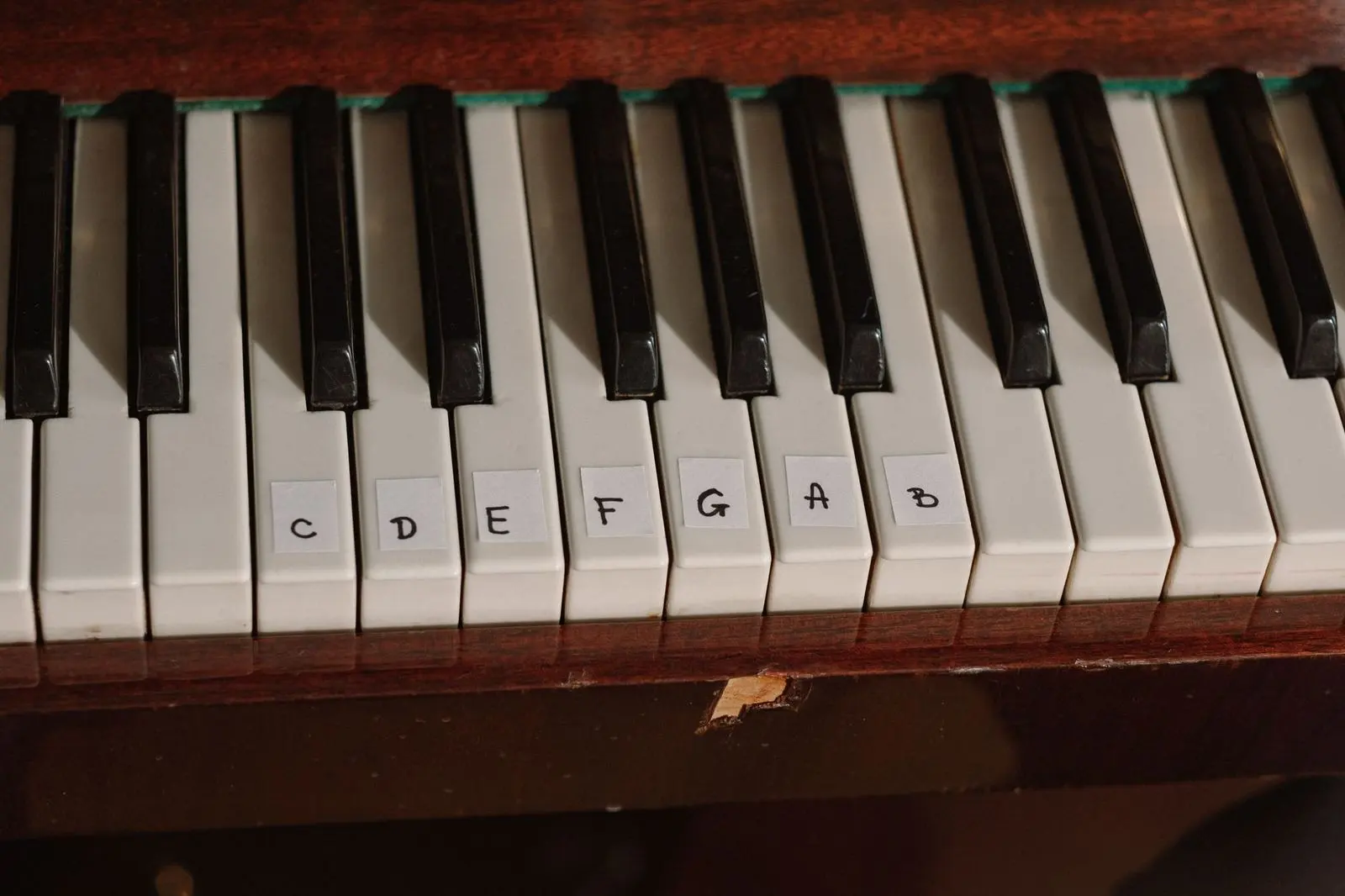
C major is the easiest place to see it. The notes C-D-E-F-G-A-B-C form a major scale beginning on C, and when played on the piano only the white keys are used, according to Wikipedia.
The two half steps in that scale fall between E and F and between B and C. Those pairs of white keys sit a half step apart, as Ableton points out.
How to spell a major scale
Spelling means choosing the right letter and accidental for every note. These steps work for any starting note.
- Name the scale for its first note, which is also its last, including any accidental on that note, as Open Music Theory explains.
- Build upward from that tonic with the whole-and-half-step order.
- Give each note a different letter name, in alphabetical order, restarting after G. A major scale will never contain both A♭ and A, says Ableton.
- Add sharps or flats wherever the pattern needs them; every major scale except C major has at least one, per Ableton.
Each black key has two possible names, so you must choose which to use as a tonic. Ableton’s lessons pick the name with the fewest flats or sharps.
Scale degree names and solfège
Every note in the scale has a scale degree name, according to Open Music Theory. Matching those names to the C major notes gives this list:
- Tonic: C
- Supertonic: D
- Mediant: E
- Subdominant: F
- Dominant: G
- Submediant: A
- Leading tone: B
Singers often use solfège instead: do, re, mi, fa, sol, la and ti, as listed by Open Music Theory. Wikipedia pairs the C major scale with do on C.
Where the major scale shows up
The scale has a central importance in Western music, particularly the common practice period and popular music, says Wikipedia. The same page gives it other names elsewhere: Sankarabharanam in Carnatic music and Bilaval in Hindustani classical music.
Chords come from the scale too. In C major, the triads built on each degree are C major, D minor, E minor, F major, G major, A minor and B diminished, as Wikipedia lists them.
Other keys keep that order of qualities but change the chord names. In D major, for example, the first triad is D major.
Written music announces the scale with a key signature. Open Music Theory says it appears after a clef but before a time signature, and our guide to time signatures covers the other half of that opening.
Once the major pattern feels natural, the minor scale is a sensible next step.
Frequently asked questions
Which major scale needs no sharps or flats?
Show answer
Only C major. Every other major scale must alter at least one note to keep its steps in order, as Wikipedia notes about C major being the sole exception.
Is the major scale the same as the Ionian mode?
Show answer
For the natural major scale, yes: Wikipedia identifies it as the diatonic Ionian mode. The same page says a few lesser-used scales, such as harmonic major and melodic major, are sometimes also called major scales.
Why does C♯ major contain E♯ and B♯?
Show answer
Each letter name must appear exactly once, so the notes in the E and B positions both need sharps to hold the step order. Ableton’s explanation says that is why some scales require these uncommon spellings.
Can I split the scale into smaller pieces?
Show answer
Yes. Wikipedia describes it as two identical tetrachords separated by a whole tone. Each tetrachord is two whole tones followed by a semitone.