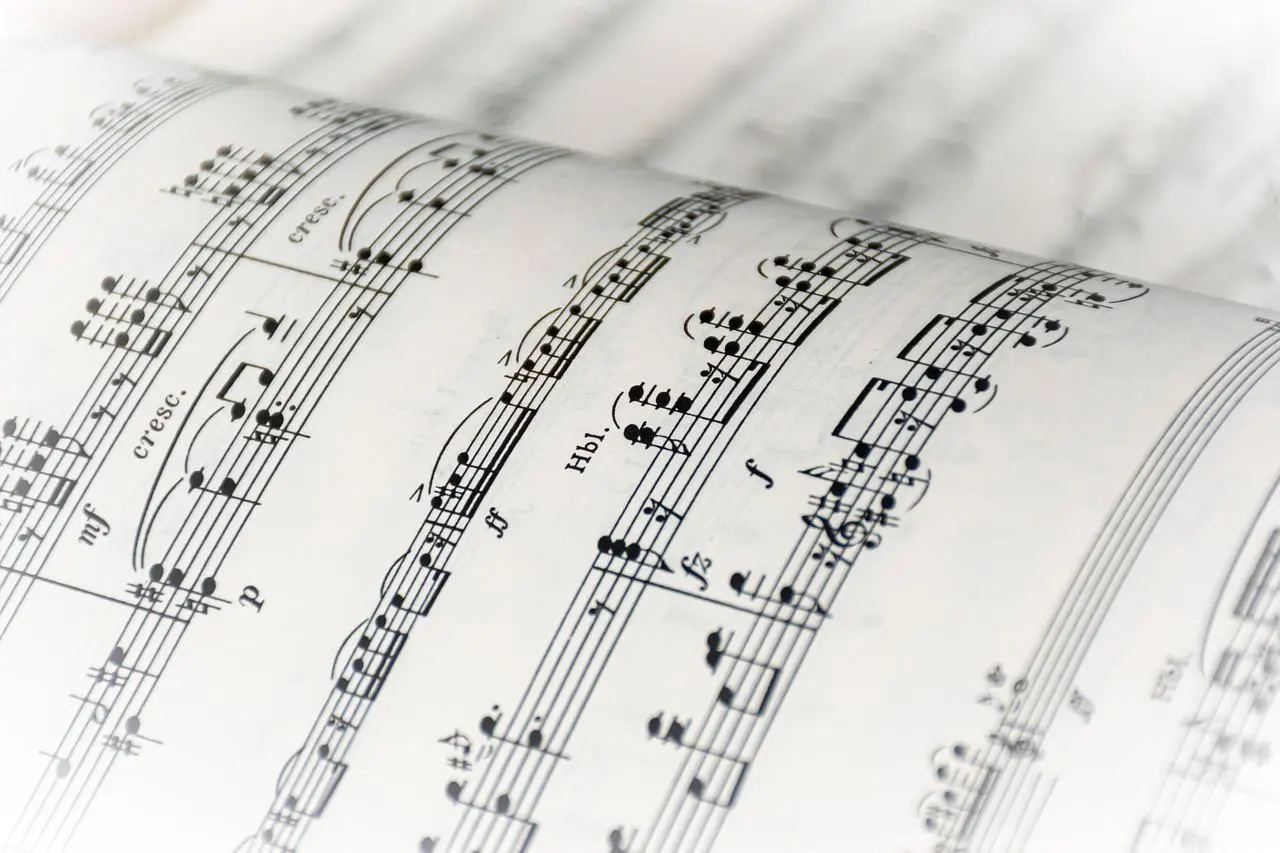

Wondering what to call the musical notes you see on a page? You only need seven letters, A to G, plus sharps and flats, to name most pitches in Western music.
This guide sits inside our wider look at music theory basics, so it sticks to names and symbols.
| Item | Value |
|---|---|
| Letter names in English | Seven letters, A to G |
| Reference pitch | 440Hz is designated “A” |
| Sharp and flat | Raise or lower a note by a half step |
| German name for B | H (in Germany and Czechia) |
| Staff used to write notes | A five-line staff |
| Hearing range of the average human | About 20Hz to 15,000Hz |
These figures come from Wikipedia’s article on the musical note and the University of Queensland’s open music theory text. They can change, so check the sources before you rely on them.
What a musical note actually is
A note is a distinct, isolatable sound, and notes are the most basic building blocks for nearly all of music, according to Wikipedia. Splitting music into separate notes also makes it easier to perform, understand and analyse.
Each written note carries two main pieces of information: its pitch, meaning how high or low it sounds, and its duration, meaning how long it lasts. Loudness and the shape of the attack are added on top by dynamics and articulation marks.
Sound itself is a smooth range, not a set of steps. The average human can detect frequencies from about 20Hz to 15,000Hz, according to the University of Queensland text, yet that text also notes that music, with a few exceptions, does not operate on those continua.
Instead, music picks out a limited set of pitches and gives each one a name. The rest of this page covers those names and the symbols that go with them.
The seven letter names, A to G
In English-speaking regions, pitch classes are typically written with the first seven letters of the Latin alphabet: A, B, C, D, E, F and G, as the Wikipedia article explains. Letter notation is also the most common way to name a note in speech or in writing in English or German, according to Wikipedia’s page on letter notation.
Every letter has a home base. In Western music, any note with a fundamental frequency of 440Hz is designated “A”, says the Queensland text.
The same letter then turns up again higher and lower. Note names can be qualified to show which octave they sound in, and the most common scheme for that is scientific pitch notation.
If you play piano, you can find the letters by looking for the pattern of black keys that separate the white ones, as the same text describes.
Sharps, flats and naturals
Notes that fit the scale of the key you are in are called diatonic. Notes outside it are called chromatic notes, and they are marked with accidentals, according to Wikipedia.
Three accidentals cover most of what you will meet:
- Sharp (♯): raises a note by a half step.
- Flat (♭): lowers a note by a half step.
- Natural (♮): cancels any accidental applied earlier.
Some notes have two spellings. C-sharp and D-flat do different jobs in tonal harmony, but physically they are the same pitch, which is why the Integrated Music Theory textbook calls them enharmonically equivalent.
Naming notes in other systems
Letters are not the only option. Several other naming systems are in everyday use around the world:
- Solfège: in many languages, including the Romance and Slavic families, notes are named by syllables such as do, re and mi instead of letters, as Wikipedia’s letter notation page describes. Fixed do ties the syllables to the C major scale, while movable do applies the same order to any major scale, according to the musical note article.
- H instead of B: several European countries, including Germany and Czechia, use H where English speakers write B, per the same article.
- Svaras: in traditional Indian music, notes are called svaras and are commonly represented by Sa, Re, Ga, Ma, Pa, Dha and Ni, according to that article.
Letter names have a long history too. The earliest known letter notation in the Western tradition appears in a textbook by the 6th-century philosopher Boethius, according to Wikipedia.
Where notes live: the staff and note values
On paper, notes are shown by placing note-heads on the lines and spaces of a five-line staff, as the Queensland text puts it. A clef fixes which line or space stands for which letter.
That is what lets a musician read a pitch at a glance. Our guide on how to read sheet music goes through clefs and staves in more detail.
Duration is shown by the note’s shape, called its note value. Each value is half as long as the one before it, and Wikipedia lists American and British names for them:
- Whole note, called a semibreve in British usage.
- Half note, called a minim.
- Quarter note, called a crotchet.
- Eighth note, called a quaver.
- Sixteenth note, called a semiquaver.
Dots can lengthen these durations, and tuplets can subdivide them, per the same Wikipedia article. Our page on note values and rests shows how they fit together in a bar.
Frequently asked questions
Do drums play notes?
Show answer
Yes, but not in the same way. For unpitched percussion, the written symbols tell the player which instrument to hit, or how to hit it, and say nothing about pitch, according to Wikipedia.
Why do some countries say do-re-mi instead of C-D-E?
Show answer
It comes down to language. Whether people reach for solfege syllables or letter names depends on where they learned music, as noted on Wikipedia’s letter notation page.
Is a note the same thing as a pitch?
Show answer
Not quite. A note can point to a general pitch class or to the specific pitch a pitched instrument plays, as Wikipedia explains.
Does the rhythm change if a melody moves to a different scale?
Show answer
No. Rhythm is separate from pitch, so a transposed melody keeps the same rhythm, according to Wikipedia’s musical note article.