
Wondering why a clarinet, a flute and an oboe sound so different? All woodwind instruments make sound in one of three ways: air split on an edge, a single vibrating reed, or two reeds working together.
This page sits within the wider topic of musical instruments, so start there if you want the full family tree.
| Item | Value |
|---|---|
| Single-reed woodwinds | Clarinets and saxophones |
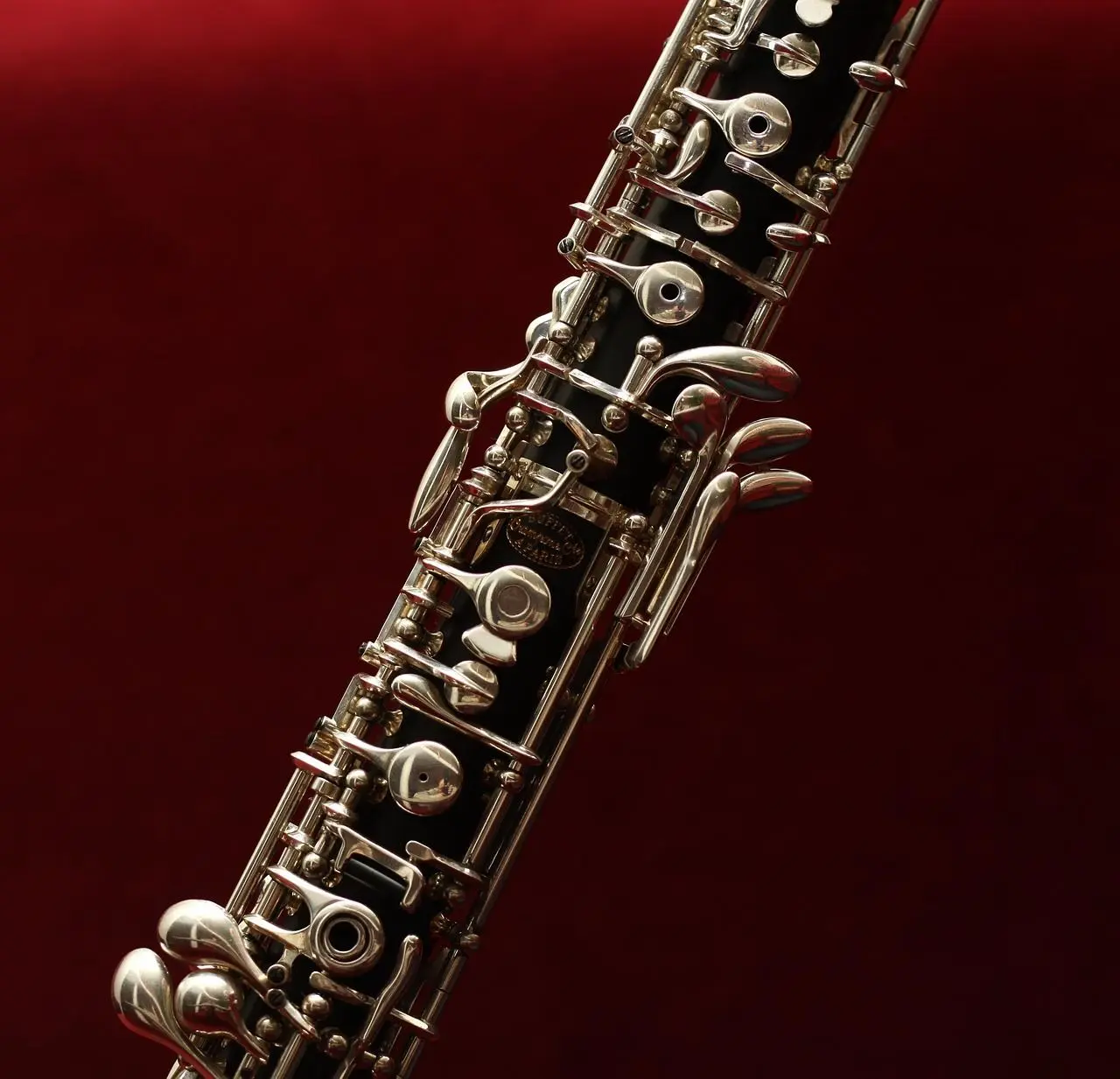
| Double-reed woodwinds | Oboes, bassoons and English horns |
| Air-reed woodwinds | Flutes, piccolos and recorders |
| Typical single-reed resonance | 2 – 3 kHz |
| Clarinet register hole position | About 1/3 the distance from the reed tip to the first open hole |
| Saxophone and oboe register hole position | 1/2 the distance from the imaginary cone apex to the first open hole |
These figures come from Stanford CCRMA’s woodwinds lecture notes. Textbook values like these can change between editions, so check the source before you rely on them.
What makes an instrument a woodwind?
The main distinction between woodwinds and other wind instruments is the way they produce sound, according to Wikipedia’s woodwind entry. Common examples include flute, clarinet, oboe, bassoon and saxophone.
Despite the name, a woodwind may be made of any material, not just wood, as the same Wikipedia entry notes. The saxophone is made of brass, yet it is considered a woodwind because it requires a reed to produce sound.
Acoustically, the feature that sets the family apart is the tone hole. A physics textbook chapter contrasts brass instruments, which are sealed systems of plumbing ending in a bell where all the sound comes out, with woodwinds, where much of the sound is radiated by the tone holes.
If you are comparing families, the guide to brass instruments covers the sealed-tube approach. Our page on string instruments covers a different way of making sound altogether.
The three sound-making families
Stanford’s acoustics notes sort the woodwinds by how the sound is started, and the lecture page lists the members of each group:
- Single reed: clarinets and saxophones.
- Double reed: oboes, bassoons and English horns.
- Air reed: flutes, piccolos and recorders.
Wikipedia boils the same split down to two mechanisms: all woodwinds either split blown air on a sharp edge, such as a fipple, or rely on the coupled oscillation of one or two reeds and an air column (Wikipedia).
Flutes, piccolos and recorders: sound from an air jet
These instruments have no reed at all. A flute produces sound by directing a focused stream of air across the edge of a hole in a cylindrical tube, as Wikipedia describes. The split airstream then acts on the air column inside, which vibrates.
Wikipedia separates flutes into open and closed types. Open flutes, such as the transverse flute, panpipes and shakuhachi, are blown across an edge. Closed flutes, such as the recorder, ocarina and organ pipes, use a duct that acts as a channel to bring the air to a sharp edge (Wikipedia).
Stanford’s notes call the mechanism an “air reed”. The air jet works as a flow-controlled valve that admits a puff of air whenever the air flow at the embouchure hole is inward directed (CCRMA).
The same source says the player can adjust three things to change register and timbre:
- Blowing pressure.
- The length of the jet.
- The area of the lip opening.
To sound the second register, the player increases the blowing pressure to speed up the jet and/or moves the lips forward to shorten it (CCRMA).
Clarinets and saxophones: the single reed
On a clarinet or saxophone, a single reed is attached to the opening of the mouthpiece with a ligature. Air forced between the reed and the mouthpiece makes the reed set the air column in the instrument vibrating (Wikipedia).
Stanford’s lecture notes model the reed as a pressure-controlled valve that admits a puff of air whenever the pressure is high in the mouthpiece. Pressure pulses reflected back from the far end of the horn tend to force the reed open, which the notes call positive feedback (CCRMA).
The reed’s own resonance sits typically between 2 – 3 kHz, according to the same notes. Players influence the result too, because lip placement on the reed indirectly controls the mass of the vibrating system.
A note only sounds steadily when the tube cooperates. Oscillations are favored when the air column has one or more resonances that correspond to the harmonics of the fundamental pitch (CCRMA).
What is different about double-reed instruments?
A double reed is made from two precisely cut, small pieces of cane bound together at the base. The bound reed is inserted into the instrument and vibrates as air is forced between the pieces (Wikipedia).
Wikipedia says this form of sound production has been estimated to have originated in the middle to late Neolithic period, and credits its discovery to someone observing wind blowing through a split rush.
Exposed double-reed instruments are played with the reed directly between the player’s lips. The family includes the oboe, cor anglais (also called English horn) and bassoon, plus many types of shawm around the world (Wikipedia).
Capped double-reed instruments such as the crumhorn cover the reed with a cap, and the player blows through a hole in that cap. In that design the lips never touch the reeds.
Cones and cylinders
Bore shape matters as much as the reed. Stanford’s notes discuss the saxophone and oboe bores as conical, and point out that a cone must be truncated so a driving mechanism can attach to the small end (CCRMA).
How do tone holes and register holes shape the notes?
Tone holes change the effective length of an air column, and the larger the hole, the more that length changes, according to Stanford’s notes. Opening holes one by one is how a player moves between notes.
The same page adds that a tone hole lattice acts as a filter that transmits high-frequency sound components but reflects low-frequency ones. Its cutoff frequency is an important factor in determining the timbre of the instrument.
Register holes
A register hole, or vent, is designed to destructively interfere with the fundamental resonance of the air column and force oscillations at the next strongest resonance (CCRMA). Where it goes depends on the instrument:
- Clarinets: ideally about 1/3 the distance from the reed tip to the first open hole.
- Saxophones and oboes: ideally 1/2 the distance from the imaginary cone apex to the first open hole.
A single vent cannot be perfect for every note. Ideally there would be a separate register hole for each fingering, and the 2001 course notes say that since this is not practical, compromises in tuning must be made. A misplaced register hole makes the second resonance sound sharp, in proportion to its distance from the ideal location.
Woodwinds in the orchestra and the concert band
The modern orchestra’s woodwind section typically includes flutes, oboes, clarinets and bassoons. Supplementary instruments include piccolo, cor anglais, bass clarinet, E-flat clarinet and contrabassoon, and saxophones are used on occasion (Wikipedia).
The concert band’s woodwind section is typically much larger and more diverse than the orchestra’s, according to the same entry. Players moving between the two settings will meet the same acoustic principles, only with a different mix of instruments.
Frequently asked questions
Does a woodwind have to be made of wood?
Show answer
No. Per Wikipedia, early flutes were cut from plants such as bamboo and hollowed branches, later ones used tin, copper or bronze, and modern concert flutes are usually high-grade metal alloys. Some, especially ocarinas, are made of earthen materials.
Do all woodwinds use a reed?
Show answer
They do not. Flutes and recorders sound by splitting an airstream on an edge, so their players never vibrate a reed at all, as Stanford’s lecture page groups them under “air-reed” instruments.
Is a bagpipe a woodwind?
Show answer
Wikipedia describes bagpipes as unique reed pipe instruments because they use two or more double or single reeds. It adds that they work like capped double-reed instruments, since the reeds never touch the player’s lips (Wikipedia).
Where can I read more about woodwind acoustics?
Show answer
Stanford’s CCRMA hosts the Musical Acoustics Research Library, a collection of archives from groups and individuals in musical acoustics research. The lecture page says our understanding of woodwind behavior owes much to Arthur Benade, John Backus and John Coltman (CCRMA).