You keep hearing trills and harpsichord runs and wonder what baroque music really is. The short answer: it is the ornate, dramatic Western art music between the Renaissance and the Classical era, led by Bach, Vivaldi and Handel.
This guide sits inside the wider music history section, which follows Western music from one period to the next.
| Item | Value |
|---|---|
| Usual dating of the era | About 1600 to 1750 |
| Monteverdi’s opera Orfeo performed in Mantua | 1607 |
| Vivaldi born in Venice, Italy | 1678 |
| Handel and Bach born in Germany | 1685 |
| Handel’s Messiah performed in Dublin | 1741 |
| Bach dies | 1750 |
The dates come from this open course overview and the timeline in People and Music. Period boundaries are approximate and figures can change, so check the source before you rely on them.
What is baroque music and when did it happen?
Baroque music is a style of Western art music composed from approximately 1600 to 1750, according to this overview. The same page says the period saw the creation of tonality and established opera, cantata, oratorio, concerto and sonata as musical genres.
The name began as an insult. The word comes from the Portuguese barroco, meaning a misshapen pearl, a negative description of the ornate music of the time, as the overview explains. In English the term acquired currency only in the 1940s.
One early critical use appeared in an anonymous, satirical review of the October 1733 première of Rameau’s Hippolyte et Aricie, noted in the same overview. The critic complained that the music lacked coherent melody and was filled with unremitting dissonances.
Historians divide the era into three phases. The overview gives these conventional dates:
- Early baroque: 1580 to 1630
- Middle baroque: 1630 to 1680
- Late baroque: 1680 to 1730
The phases overlap, and scholars have long disagreed about the time boundaries of the period, especially when it began.
Core features: basso continuo, ornament and contrast
The signature sound rests on basso continuo, a continuous bass line over which a harpsichord, organ or lute added chords, as People and Music describes. Players read numbers written under the bass, a system called figured bass that allowed more freedom than writing out every note of the chord.
On top of that foundation, even the simplest melodies were decorated with trills, acciaccaturas, appoggiaturas and mordents, because ornamentation became ubiquitous, according to Classical Music magazine.
Sources still debate how far baroque music shares aesthetic principles with the visual and literary arts. A fairly clear shared element is a love of ornamentation, as this music appreciation text puts it.
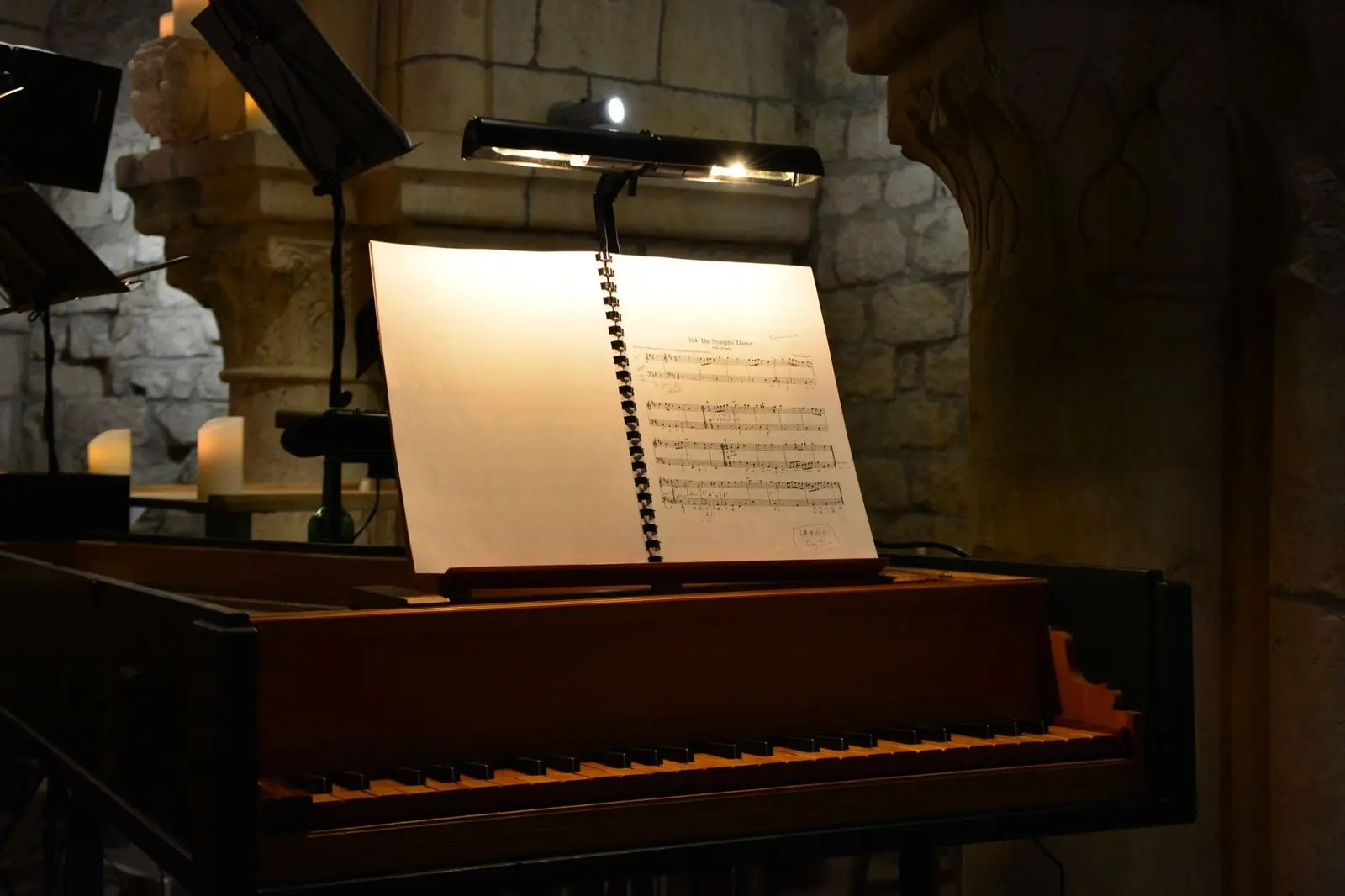
Beyond ornament, a few traits are easy to hear once you know them:
- Terraced dynamics: sudden, dramatic changes in volume or texture create stark contrast, as People and Music notes.
- One mood per piece: baroque music often sought to evoke a specific emotion, with an entire piece reflecting one mood (same source).
- Tonality and keys: the era saw the emergence of equal temperament and the establishment of the 12 major and minor keys still used in Western music, according to Classical Music magazine.
Early baroque: the Camerata, Monteverdi and the birth of opera
The Florentine Camerata was a group of humanists, musicians, poets and intellectuals in late Renaissance Florence who met to discuss and guide trends in music and drama, as the overview explains. They rejected their contemporaries’ use of polyphony and instrumental music, and discussed monody: a solo singer accompanied by a kithara.
Their early experiments, including Jacopo Peri’s Dafne and L’Euridice, marked the beginning of opera. Opera was in turn a catalyst for baroque music, according to the same page.
Claudio Monteverdi worked for the Duke of Mantua, where he wrote Orfeo (1607), an opera based on the myth of Orpheus, as People and Music recounts. He kept two styles alive: Renaissance polyphony, called prima pratica, and the new basso continuo technique, called seconda pratica, per the overview.
Opera also turned music into a business. Survey of Western Music argues that the era was essentially the first age in which music became a commercial commodity, and compares seventeenth-century opera to the movies of today.
Bach, Vivaldi and Handel: three late baroque voices
Three names dominate the late period. Bach and Handel were both born in Germany in 1685, while Vivaldi was born in Venice, Italy, in 1678, according to the People and Music timeline.
- Johann Sebastian Bach died in 1750. He spent all of his life in Germany and wrote much of his music for the Lutheran church, per Classical Music magazine, and his listed works include the Brandenburg Concertos (1721) and the St Matthew Passion (1727), according to this music appreciation text.
- Antonio Vivaldi is best known for The Four Seasons (1723), listed in the same text. Classical Music magazine points out that it is one of the most popular baroque works and an instrumental one.
- George Frideric Handel wrote Water Music (1717) and Messiah (1741), according to that text. The People and Music timeline places a performance of Messiah in Dublin, Ireland, in 1741.
Other names help fill out the picture. Purcell’s Dido’s Lament is a famous example of ground bass, a repeated bass line, according to this text. Pachelbel’s “Canon in D” is used in many modern weddings, as Survey of Western Music points out.
How baroque music differs from what came before and after
Music of the Medieval and Renaissance periods developed in complexity from monophonic melodies to polyphonic works, as People and Music describes. For that earlier style, read this guide to renaissance music.
The baroque then broadened what music could do. It expanded the size, range and complexity of instrumental performance, according to the open course overview.
As the baroque gave way to the classical period, the role of ornament was greatly diminished in both music and architecture, per this music appreciation text. You can follow that next stage in this guide to classical period music.
A starter listening list
Begin with works that Classical Music magazine counts among the period’s blockbusters:
- Monteverdi: Orfeo, an early landmark of opera (see People and Music).
- Vivaldi: The Four Seasons and Gloria.
- Bach: the Brandenburg Concertos, the Goldberg Variations and the Toccata and Fugue in D minor.
- Handel: Messiah and Zadok the Priest.
The same guide calls this list only the tip of a colossal iceberg and invites you to chip away at it yourself.
Frequently asked questions
When did the baroque period start and end?
Show answer
Most surveys place it from roughly 1600 to 1750, the year Bach died, as this overview and this timeline show. Treat the edges as soft: some phase dating starts the early baroque as far back as 1580.
Why is it called baroque?
Show answer
Jewelers still use the word for irregular or imperfectly shaped pearls, which hints at how critics first saw the style. A later step came in 1888, when Heinrich Wölfflin gave the word a stylistic meaning, according to Survey of Western Music.
Which instruments are typical of baroque music?
Show answer
A harpsichord, organ or lute usually supplied the chords beneath a bass line. Composers also embraced instrumental music more fully, and Classical Music magazine cites Vivaldi’s Four Seasons as a popular instrumental example.
Is Pachelbel’s Canon in D baroque?
Show answer
Yes. Pachelbel appears alongside Bach and Handel in the list of baroque-era composers in the open course overview.