
If a keyboard of 88 keys looks overwhelming, you’re in good company. Piano keys and notes follow one repeating pattern: find a group of two black keys, and the white key just left of it is C.
When you are ready to look beyond the keyboard, the hub on musical instruments is a good place to start.
| Item | Value |
|---|---|
| Keys on a full-size piano | 88 keys |
| Notes in one octave | 12 notes |
| Lowest note | A0 |
| Highest note | C8 |
| Usual name for the C near the centre | Middle C, written C4 |
| Black key pattern | Alternating groups of two and three |
These figures come from Dobrian’s music theory notes and MusicRadar’s beginner guide. Figures can change, so check the source before you rely on them.
Find your way with the black key groups
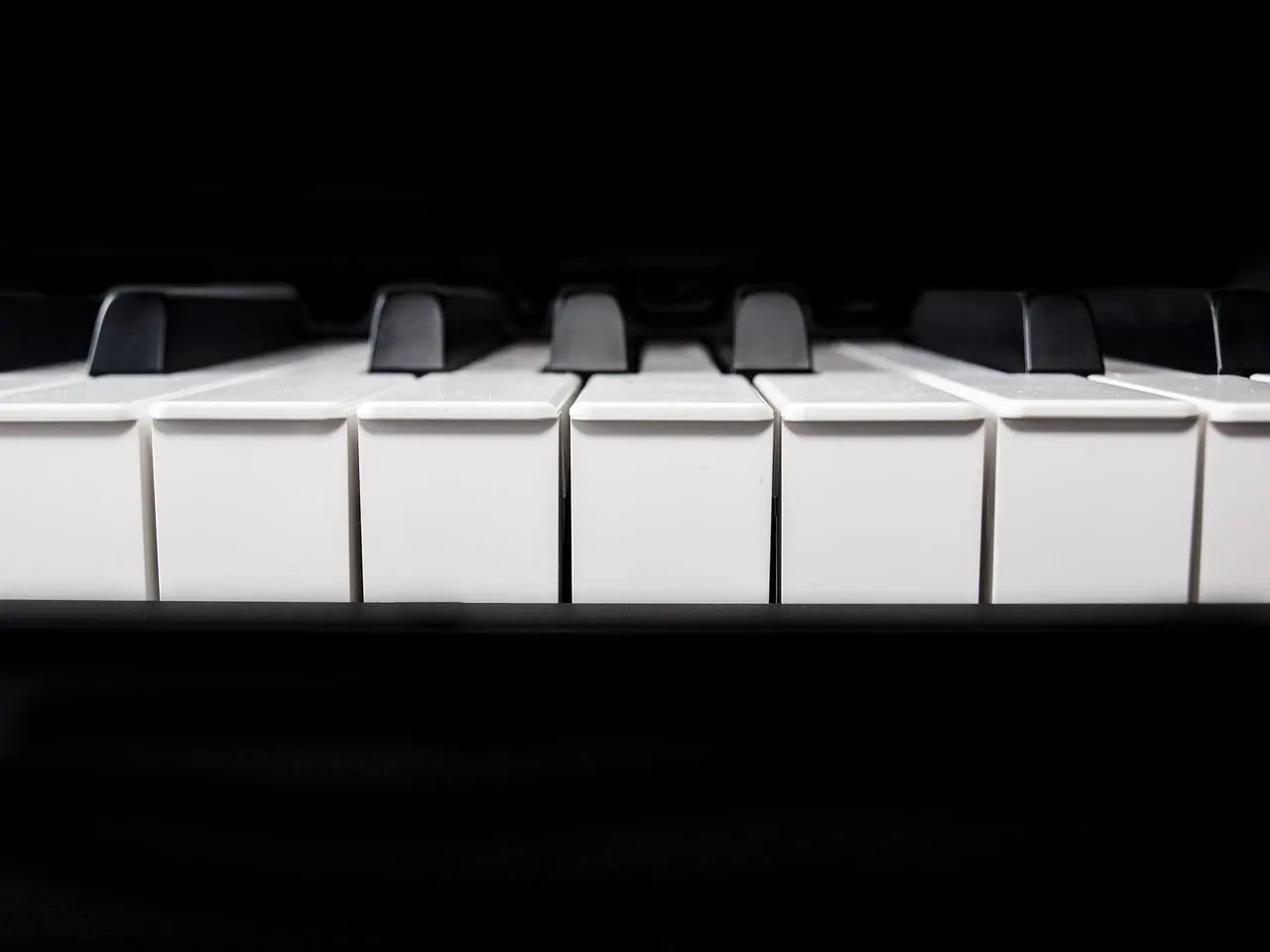
A full-size piano has 88 keys, yet the layout is simpler than it looks. According to Dobrian’s notes, the black keys sit in alternating groups of two and three, and pianists use that repeating arrangement to orient themselves.
Direction helps as well. Notes rise in pitch as you move to the right and fall as you move to the left, so a key’s position tells you whether it sounds higher or lower.
Two landmarks unlock the white keys:
- Find a group of two black keys: the white key immediately to its left is C.
- Find a group of three black keys: the white key immediately to its left is F.
Both rules, set out in MusicRadar’s guide, work anywhere on the keyboard. Once you can spot a C and an F, every other white key is a short step away.
Naming the white keys
White keys use the letters A to G, then the cycle starts again. Counting begins at C rather than A, which Dobrian’s notes describe as musicians’ custom.
To find any white key, follow these steps:
- Find a group of two black keys and rest a finger on the white key to its left. That is C.
- Move up the white keys one at a time: D, E, F, then G.
- After G, the letters wrap around to A and B, and the next white key is C again.
A second anchor is A. According to MusicRadar, counting two white notes down from a C lands you on A, which gives you a third landmark beside C and F.
Sharps, flats and the black keys
Every black key carries two names. MusicRadar explains that you start from the white key just to the left and add a sharp sign (#), which gives C#, D#, F#, G# and A#.
Going the other way, start from the white key just to the right and step down, adding a flat sign (b). That produces Db, Eb, Gb, Ab and Bb, as the same guide shows.
- C#/Db sits between C and D.
- D#/Eb sits between D and E.
- F#/Gb sits between F and G.
- G#/Ab sits between G and A.
- A#/Bb sits between A and B.
Paired names like these are called enharmonic equivalents. The spelling you meet on the page depends on the key the music is in.
The idea can point at white keys too. Dobrian’s answer key gives E# as another name for F and Cb as another name for B, which makes sense because no black keys sit to the left of C or F. The same page urges you to learn both the sharp and the flat name of every black key.
Octaves, middle C and note numbers
The keyboard is the same group of 12 notes, or octave, repeated seven times with a few extras at the top, says MusicRadar. Travelling from one C to the next C covers a single octave.
To tell the repeats apart, musicians add a number. On a keyboard the lowest C is C1, then C2, then C3 and so on, and C4 earns the nickname middle C, according to Dobrian. It sits roughly, but not exactly, in the middle of the keyboard.
The number changes at C, not at A. Going up from C4, the notes run to B4 and then C5, so the count ticks over between B and C.
The whole range runs from A0 at the bottom to C8 at the top, and MusicRadar counts eight C-notes in total. Per Dobrian, most notes occur seven times, while A, A#/Bb, B and C occur eight times.
Why the keyboard looks the way it does
Because the piano is the most commonly encountered keyboard instrument, its layout is often just called piano keys, as Wikipedia’s musical keyboard entry notes. The same entry says keyboards typically hold keys for the twelve notes of the chromatic scale, repeating at the octave.
The longer keys are the seven natural notes of the C major scale, and the shorter, raised keys cover the rest. White keys form a diatonic scale, while black keys form a pentatonic scale.
Colour has a practical history. White keys were traditionally covered in ivory, and black keys, which receive less wear, were often made of black coloured wood. Many instruments from before the nineteenth century, such as harpsichords and pipe organs, reverse the colours, using ebony for the natural notes.
The longer-and-shorter key pattern itself dates to the 15th century, per Wikipedia. Most pianos made since about 1870 have 88 keys, and the lowest pitch of an 88-key piano is 27.5 Hz.
Smaller boards exist too. The same entry says synthesizer keyboards commonly have 61, 76 or 88 keys, and small MIDI controllers come with 25 keys, so a compact keyboard simply gives you fewer octaves to move across.
If you are still choosing between instruments, the guide to the best instrument to learn first can help you weigh the decision.
Drills that make the layout stick
Dobrian suggests a simple self-study drill: at a keyboard or piano, play every C as fast as you can from the lowest up to the highest and back down, then repeat the exercise for each of the other eleven notes. The same page advises drilling regularly and points to online quizzes for note identification.
A short daily routine could look like this:
- Play every C from the bottom of the keyboard to the top, then back down.
- Repeat with F, using the three-black-key landmark.
- Press each black key and say both of its names aloud.
- Finish with an online note-naming quiz.
Once the piano layout feels familiar, the guide to transposing instruments shows how note names can work differently on other instruments.
Frequently asked questions
Why do musicians start at C instead of A?
Show answer
It is a long-standing habit rather than a rule of logic. C also sits right beside the two-black-key group, so the starting letter and the visual landmark line up, as Dobrian describes the custom.
Is C# a different key from Db?
Show answer
No. It is one key with two spellings, and the key of the music decides which spelling gets written, according to MusicRadar.
How do I find middle C on a full-size piano?
Show answer
Look for the C labelled C4. On a full-size piano you can count up to the fourth C from the bottom, since Dobrian warns the physical centre is only an approximation.
Can a sharp or flat be a white key?
Show answer
Yes, in two spots. Where no black key sits between neighbours, a sharp or flat name lands on a white key: E# is the key also called F, and Cb is the key also called B, per Dobrian.
Is there a note called H?
Show answer
In the German system, yes. MusicRadar says H replaces the B used in the UK and US.